Water Left Standing After Rain
Rings of dirt mark where water sat for days. Ponding speeds up membrane aging and finds every weak seam, so a new roof in that spot gets tapered insulation that pushes water toward the drains.

As a Terre Haute commercial roofing contractor, we install and replace TPO, EPDM, and metal roofs on commercial buildings, starting every job with a roof walk and core cuts.
Most Terre Haute commercial roofing work starts with one of these six roof conditions. Each one tells us where to cut cores and what the new system has to handle.
Rings of dirt mark where water sat for days. Ponding speeds up membrane aging and finds every weak seam, so a new roof in that spot gets tapered insulation that pushes water toward the drains.
Taped EPDM laps lift at the corners, and older TPO welds split along their edges. Once failed seams show up across the whole field, a patch program costs more over the years than a new membrane.
Soft spots underfoot and blisters point to water trapped below the sheet. A core cut shows how far it spread, and saturated boards come out during tear-off because wet insulation holds weight and loses its R-value.
Shrinking membrane tugs at parapet base flashings and curb wraps until the corners open. Wall flashings are the first detail rebuilt on a new roof, with fresh termination bars and counterflashing above them.
Exposed-fastener metal roofs on shops and storage buildings lose their washers and start rusting at the laps. Panels rusted through get replaced, and the frame is checked to see whether a retrofit can go over it.
Snow melts by day and freezes in the drain bowl by night, so meltwater backs up under the laps. New roofs here get clear drain sumps, clean edge metal, and seams set above the waterline.
One work order follows the job from the first roof walk to the last seam probe, so you always know which section is open.
We walk every section, photograph drains, curbs, and edges, and cut small cores to read the layers and the moisture. Those findings decide between recover and tear-off before anyone talks price.
A written scope lists the layers coming off, the insulation going on, the membrane or panel, every curb and drain detail, and the edge metal. The price comes from those measurements.
Docks, entrances, and production areas get mapped so each day's tear-off sits over space you can work around. Rooftop units that need a shutdown are listed with dates.
Each section is opened, the deck is repaired, new insulation goes down, and the membrane or panels follow. Every opened area is sealed watertight before the crew leaves the roof.
Welded seams get probed, flashings get checked by hand, and drains get cleared of debris. Then we walk the finished roof with you and hand over photos of each detail.
Four roof systems cover the commercial buildings we work on. Each card names the seam or attachment, the buildings it fits, and what we check first.
 Welded Seams
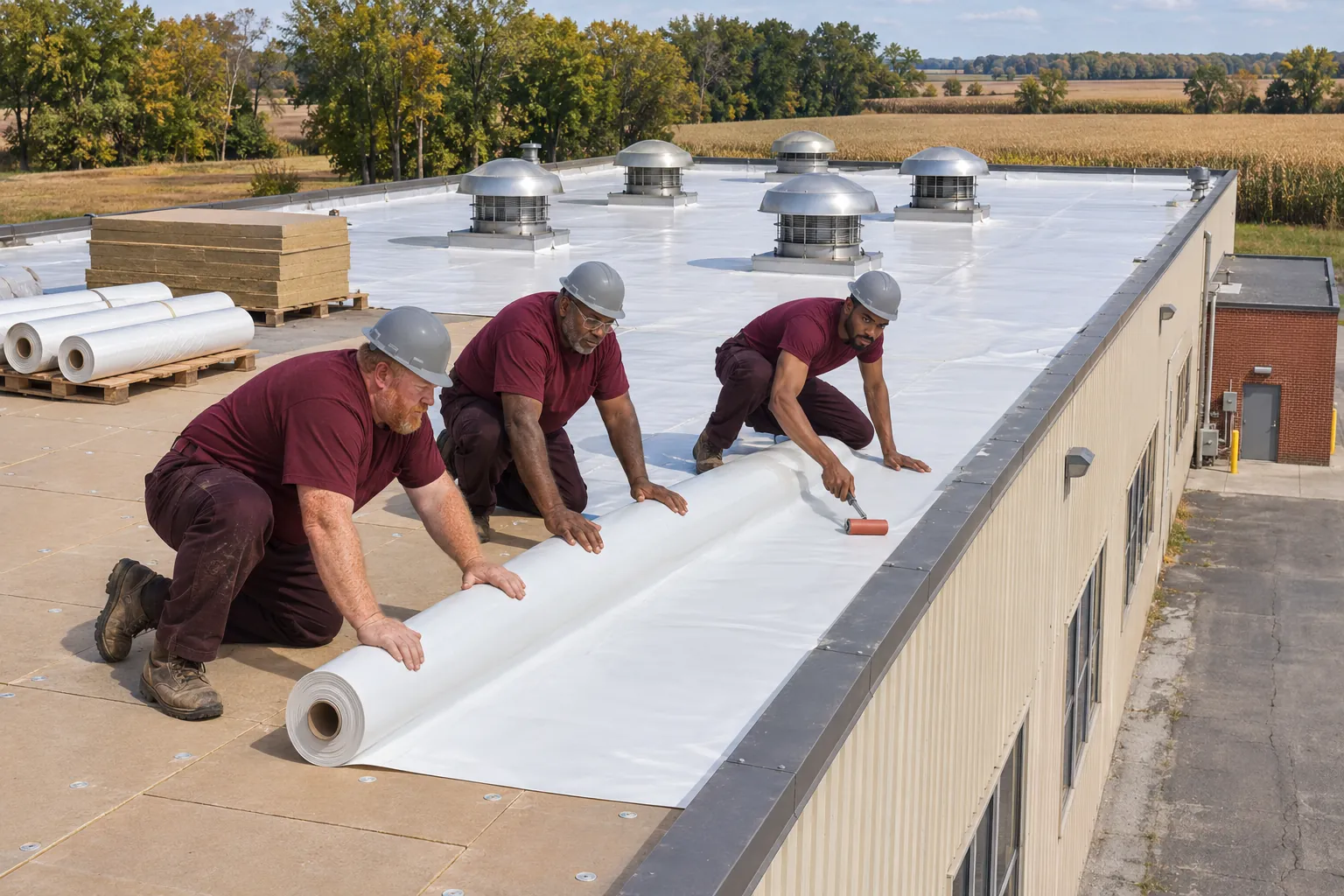
White TPO sheets are heat-welded into one surface over new insulation. The reflective top helps buildings with summer cooling loads, and walkway pads protect the paths to rooftop units on busy roofs.
 Taped Seams
Black EPDM rubber comes in wide sheets with few seams and stays flexible through Indiana winters. Later patches are simple, which suits owners who plan to keep a building for decades.
 Flashed Curbs
Plant roofs carry fans, ducts, and process exhaust, so the system gets chosen around the equipment. Curbs are raised to clear new insulation, and sections follow your shifts and shutdowns.
 Standing Seams
Standing-seam and exposed-fastener panels go on sloped roofs, or on a retrofit frame over a tired low-slope roof. Panels shed snow fast and span purlins on shops and farm buildings.
Call and describe the stain, the drip, or the wet ceiling tile. We ask what sits on the roof above it and send someone up.
Call UsSend the address and a few lines about the building. A roof walk and core cuts come first, then a written scope.
Get A Free EstimateThree paths cover most commercial roofs we walk. The core cuts and the age of the system decide which one fits your building.
A new roof changes daily life in the building for more than one person. Here is what each of them notices first.
We install and replace commercial roofs in Terre Haute, Brazil, Linton, Clinton, Pittsboro, and Sullivan.
Outside these towns? Call us or send us a message.
Home base: plants, warehouses, offices, and downtown blocks.
Seasonal work windows and nightly tie-ins on Clay County roofs.
Shops and storage buildings sharing one long roof.
Metal buildings joined to low-slope plant roofs.
Big warehouse roofs replaced around dock schedules.
Recover or tear-off, decided by the layers already up there.
Pick a roofer who cuts cores before quoting and puts the deck, insulation, and drain plan in writing.
Ask how your doors, docks, and shifts will keep running, who pulls the city permit, and how each section gets sealed at night. Then compare written scopes item by item.
Roof size, rooftop traffic, and cooling load usually settle it.
White TPO with welded seams reflects summer sun and handles busy roofs with walkway pads. Black EPDM with taped seams stays flexible in January and patches easily. We weigh both against your drains, penetrations, and the roof that is up there now.
Service life comes down to the system, the install, the drainage, and the upkeep.
TPO and EPDM roofs often run 20 to 30 years, and metal roofs often longer. Standing water, foot traffic, and neglected flashings cut that short, while spring and fall checks with quick fixes push a roof toward the long end.
Measured roof area and the layers coming off set most of the price.
Deck repairs, insulation thickness, the membrane or panel, and the count of curbs, drains, and penetrations add to it, along with crane time and work around operations. A free roof walk measures all of it before a number goes on paper.
Both. Full replacement takes the roof to the deck and puts down new insulation, a TPO, EPDM, or metal system, flashings, and edge metal.
Large roofs go section by section so tenants and production keep working, and each opened section is sealed before the crew comes down.
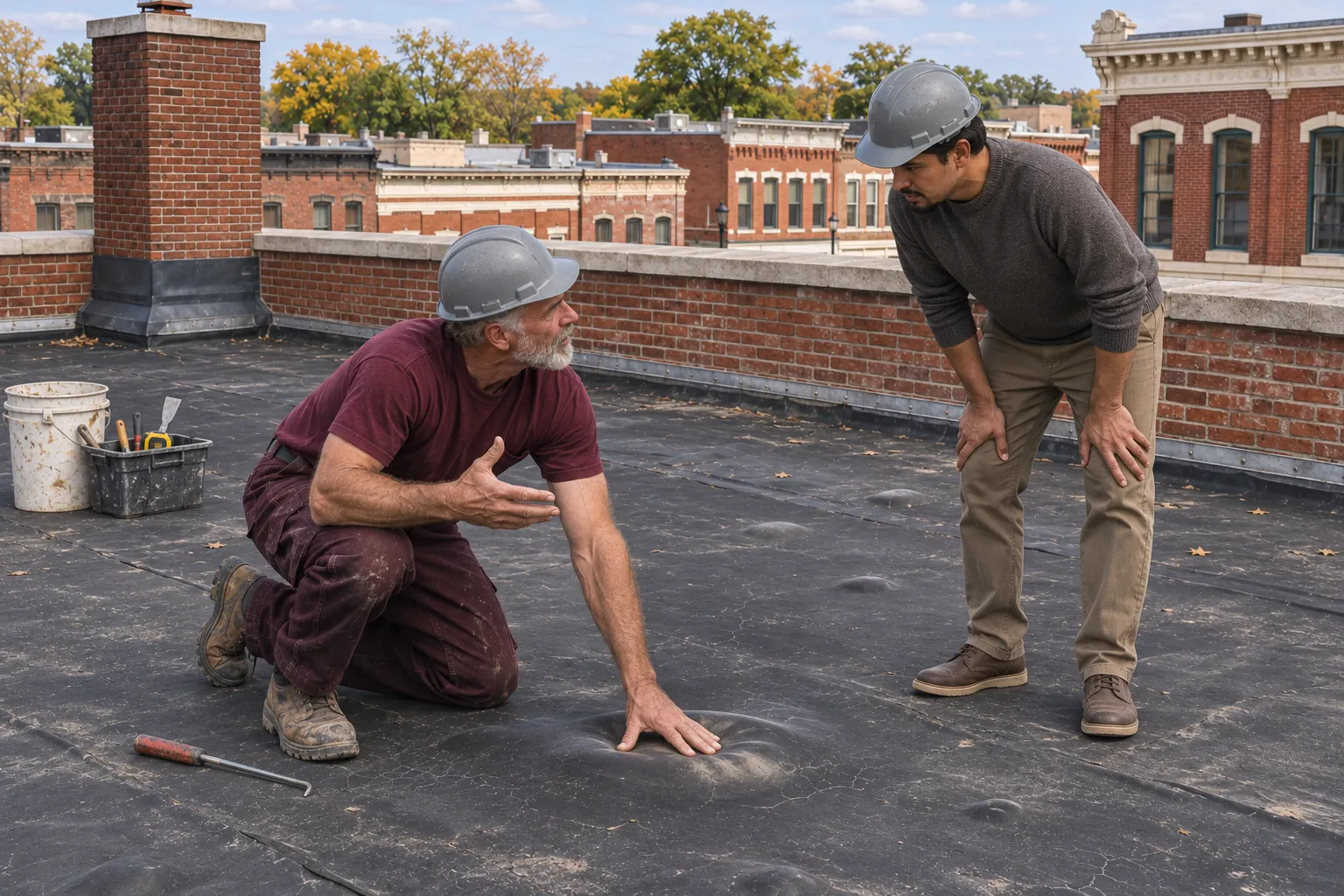
Send the address and what the roof is doing. We set up a roof walk, cut cores, and price the system that fits.